Reviewing how to tell time during Calendar Math/Every Day Counts (EDC)

 To access Compass Odyssey, your child’s needs his/her assigned username and password.
Has your child checked what in his/her Compass backpack lately?
 This is another online resource available to all DCPS students. I use this software as a tool to assess or help build foundational skills and concepts in math and reading. This software is available to your child on any computer that has Internet access. To access Destination Learning, your child’s needs his/her assigned username and password.
Has your child had a chance to access Destination lately?
 To me (the teacher)… Number Worlds is an online resource I use as a tool to assess or build foundational skills and concepts in math. To your child (the student)… it’s computer fun time!
 Remember, this is a tool available to your child in the classroom. In addition, this fun interactive software is accessible to your child wherever he/she uses a computer with Internet access (i.e. at home or library).
Has your child had a chance to explore Number Worlds lately?
 How can you help at home? Give your child a math sentence/equation (i.e. 10-4 = 6) and asked them to tell you all of the related math sentences/equations. Remember, the same numbers are in each math sentence/equation in a fact family.
  What is the missing related subtraction math sentence?

Our prediction was that we would all have about the same measurements. Uh, oh! Some of us measured Tape A and we came up with some interesting results.

Why do you think we have some different results?
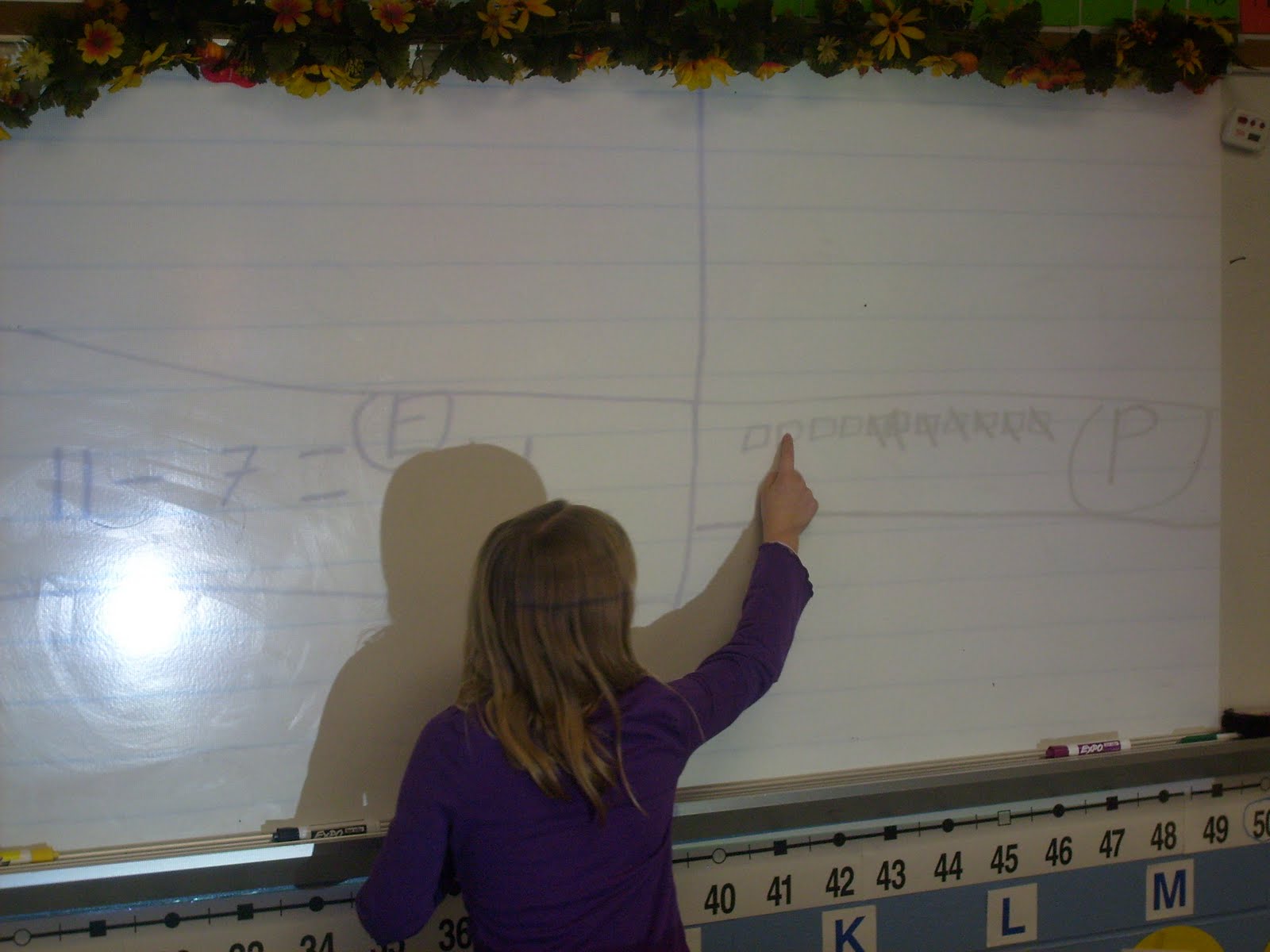 Explaining to the class her math strategy used to solve a subtration story problem.

What strategies do you use to calculate the coins' value?


